Showing posts sorted by date for query A to Z. Sort by relevance Show all posts

Friday, May 22, 2020

Gold Rush Days - Day 9 - 21 Day Family Connections Experiment


It's Day 8 of my 21 Day Family Connections Experiment.


These and other old stock certificates were framed and hung on our 'rec room' walls. I don't remember what year dad fixed up part of the basement for my brother and I and our friends. I do remember playing there when I was first in school, but a few years after that he panelled the walls to make it look a little nicer (it was probably warmer then too) and that's when he built himself a little office.  

We had a ping pong table in there, and an older record player. And a sofa and my grandparents' old dining room table and chairs. 

I doubt we gave the certificates much thought, although I knew what they were. Dad said by then they were just for looking at. 

Sometime in the 60s - the 1960s - Dad and I went to the Public Library in downtown Vancouver and researched most of them. He wanted to know if any companies had been bought out, as the certificates might then be worth something after all. We did find a couple which I believe he sold. I thought the research was fun, and I will say, I remember the librarians in the business section were very helpful! 

He was philosophical about the certificates that weren't worth anything except as pretty paper. But some of these he'd known about through his early employment. In 1937 and 1938 when these shares were bought, he was working for A. J. Smith. Arthur J. Smith was Finance Editor for the Vancouver Sun for some time and well known in the city. He had opened a new company by 1937 as A. J. Smith, Seasoned Securities, 829 W. Pender. The previous company, Smith, A. J. & Co. Ltd. continued under other management, 481 Howe St.

Zeballos Gold Peak Mines Limited. Incorporated in British Columbia, Canada. 
100 Shares bought January 1938 by George W. Rogers (my father). 


Lightning Creek Gold Mines Limited, Incorporated in British Columbia, Canada. 100 Shared bought April 1937 by Joseph Rogers (my grandfather).


These particular certificates are more interesting to me as history than as 'collectable paper'. Mining, especially gold mining, has always been important in BC, and its allure is enduring. 

Both these mining locations have had lots of interest over the years. Zeballos is on northwest Vancouver Island. Even the early Spanish explorers may have searched for gold there.  And Lightning Creek is in BC's Cariboo gold rush area, near Barkerville, taken up fully with mining claims in the 1860s. 

Charles Unverzagt, brother of Jonas T Unverzagt who signed the 1937 certificate, had worked there from the 1910s under the company name: Lightning Creek Gold Gravels and Drainage Co. (See "Annual Review of the Mining Industry", The Nelson Daily News, Nelson, BC, Tuesday, 3 January, 1911, page 10.) 

By the 1930s, the town area was known as Wingdam. The BC Archives has photographs showing some of the operations there, apparently all from the 1930s. If you follow this link later and search the 1937 BC Directory for Wingdam, you will see why people were optimistic about mining there then.

And another company, Omineca Mining, is working in that area now. See The Wingdam Gold Project.

BC Archives photograph, Item E-04520 - Wingdam. Keystone Drill In Operation At The Mine, Consolidated Gold Alluvials of BC, dated 1937. Photographer unknown. See other photographs on the BC Archives website. Jonas T. Unverzagt was President of Consolidated Gold, and the same B. M. Richardson was Secretary.

Now, even with the shutdown, it is much easier to research older companies in British Columbia. I did consider using the Zeballos certificate for the Z entry in this year's A-Z blogging challenge to show this. But there's still more in the BC Archives! Watch for an article on this topic later this year.


For more about the 21 Day Family Connections Experiment, see my first Experiment article here.

Thursday, April 30, 2020

Z - Zed is for Time Zones - Blogging from A to Z April 2020 Challenge!

Today Z - Zed is for Time Zones


  Blogging about British Columbia Genealogy Resources


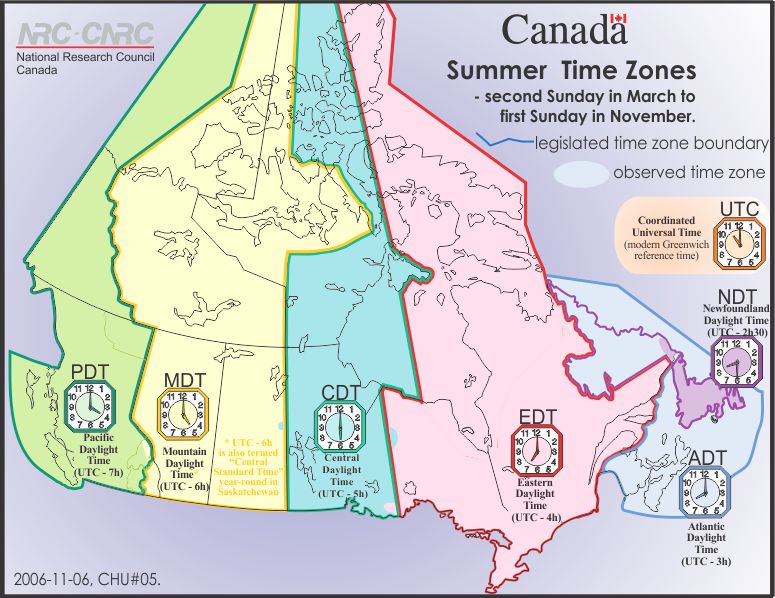
Standard Time map for Canada, National Research Council Canada. In British Columbia (and the Yukon), Daylight Saving Time mostly begins the second Sunday in March at 02:00 PST and ends the first Sunday in November, 02:00 PDT. Spring ahead; fall back - one hour. 

Except where time doesn't change or join the majority! If you follow the BC/Alberta border on the winter map and watch the colours, you will see where it's always summer time in BC - Charlie Lake, Chetwynd, Dawson Creek, Fort Nelson, Fort St. John, Hudson's Hope, Taylor and Tumbler Ridge: all Mountain Standard Time, never Daylight Saving. Then there's Cranbrook, Fernie, Golden, Invermere, and Sparwood: all Mountain Time but with Daylight Saving. Except for Creston: Mountain Standard Time, no Daylight Saving. Got it? 

This used to seem more important in the days not too long ago when a long distance call to family or friends was a treat, but you didn't want to wake people up. Now we text; we e-mail - conversations often have time gaps, no problem. 

But right now, this year, many of us are video chatting and attending online meetings and genealogy talks all across the world. As I was musing yesterday, time zones suddenly matter. Here's BC in Canada above; follow this link to a world map like I wanted for my fridge. Click on a country's link to learn about its time quirks.

Some families may have stories about time changes - funny or not, depending on if you missed a train or flight by not paying attention. 

I remember the first time I went to Ottawa - all by myself - on a plane. My mother, who I thought was sometimes a fussbudget, impressed on me that I must call her as soon as I got there to let them know I had safely arrived. And, good girl that I was, I went right to a pay phone, put all my change in and called her. Only to hear her say, "Diane, it's 1 am!!" Oh, well! Whose fault was that? I never forgot and I don't think she did either. 


The Honourable Donald A. Smith driving the last spike to complete the Canadian Pacific Railway. 7 Nov. 1885, B.C. B&W albumen print; Photographer: Alexander Ross, Best & Co., Winnipeg. Credit: Alexander Ross / Library and Archives Canada / C-003693.


Here's Sandford Fleming in his big beard and top hat watching the driving of the last spike on the Canadian Pacific Railway at Craigellachie, British Columbia, 7 November 1885, at 9:22. 1 We owe our time zones to him. A Scottish emigrant to Canada, he was a renaissance man able and interested in many things, He had surveyed the CPR route through the Rockies and now was a CPR director.

He called his world time concept 'Cosmic Time', using Greenwich Time, a 24 hour clock, and allowing for local time zones. In an paper to the Smithsonian Museum in 1886, he wrote 

"At midsummer, 1886, the Canadian Pacific Railway was opened from the Atlantic to the Pacific [Port Moody, BC] and the 24-hour system went into force in "running" through trains. The example set by the railway has been followed in the towns and villages along the lines, and the inhabitants generally having experienced the advantages of the change, no desire is expressed in any quarter to return to the old usage." 

A little optimistic, he was. Train schedules might be in the 24-hour clock but few likely used it in in ordinary (non railway/non military) life. Fleming goes on to include a footnote 2 reporting how easily an extra dial, even a paper one, can be added to a watch to show the 24 hour clock in Arabic and Roman numerals. I bet he'd done that. I wonder if there's a watch of his in a collection somewhere?

Other transportation systems didn't use the 24-hour system and, for that reason, and others, many times the 'Daylight Saving' question has come up. It was first imposed nationally in Canada during WW I and again provincially during WW II although so many objected it was lifted within a few months. The intention was supposed to save fuel and give more daylight hours for work, for example, at WW II shipyards, and time for recreation, including gardening. Many, especially in rural areas, have always opposed 'changing the clocks'.

In 1920, in Chilliwack, for example, a farmer interviewed had this to say about keeping Daylight Saving:

FARMER TALKS DAYLIGHT SAVINGS

Interviewed by a Coast newspaper representative upon the daylight saving question, Mr. A. Mercer is quoted as saying: “In 1918, the excuse for daylight saving was ‘gasoline’,  in 1919, the excuse was ‘war gardens’, and this year it is ‘lawn bowling’. 3

 Both the City of Chilliwack and the District of Chilliwhack had agreed to ask the British Columbia Electric Railway (BCER) to go on Standard Time, "normal time" as daylight saving schedules caused hardships for milk shippers and others. The Surrey Board of Trade had forwarded a resolution opposing the switch to Daylight Saving Time, pointing out the "dislocation" to business, farmers and others, including school children who might have to leave school early to catch the train.  The Chilliwack Retail Merchants Association, however, supported Daylight Saving. 4

At the 1920 BC Dairymen's Association Convention in Vancouver, no one spoke up for Daylight Saving. As one Washington breeder said,

...the farmers of the U.S. found the cows would not work with the new clock, that the dew appeared on the old schedule and the children would not go to bed with the new time. 

The BC Minister of Agriculture said it unlikely any such legislation would be heard at the coming session. 5

It wasn't till 1952 that a provincial plebiscite approved Daylight Saving for British Columbia, but rural areas were still against it.

REFERENCES

1. An article about this event and the photograph is on Canadian Pacific Railway Set-off Siding. 

2."Time Reckoning for the Twentieth Century", Annual report of the Board of Regents of the Smithsonian Institution, 1886, Washington [DC], 1889,  pages 345-366. "At midsummer...." quotation and dial footnotes, page 355.

3.  The Chilliwack Progress, Chilliwack, BC, 25 Mar 1920, Thursday, p. 1.

4. The Chilliwack Progress, Chilliwack, BC, 10 June 1920, page 1.

5. The Chilliwack Progress, Chilliwack, BC, 29 January 1920, page 7.

CATCH UP ON ALL MY A-Z APRIL 2020 BLOGGING CHALLENGE ARTICLES - https://canadagenealogy.blogspot.com/2020/04/my-blogging-for-a-to-z-april-challenge.html

Wednesday, April 29, 2020

Y is for Year? - Blogging from A to Z April 2020 Challenge!

Today Y is for The Year


  Blogging about British Columbia Genealogy Resources


©1905, J. S. Ogilvie Pub. Co. Unused comic postcard. Personal collection.

Well, Y was a hard one! I had planned to do the Yukon Territory but after the CO-VID 19 shutdown I decided that was a no go. I swapped out a number of the planned topics and resources for this A-Zed series. I'll get back to them - later. 

Talking about the Yukon always seems a pretty natural thing here even in southern BC. British Columbia and the Yukon have always had family, commercial and economic ties (as does Seattle, Washington State.) Of course, most of us think Gold! when they hear someone went there. Only a few made it big; some miners and entrepreneurs stayed; some returned home; some settled in parts of BC or in Alaska.

In fact, in the 1930s, it looked as if the Yukon would become part of British Columbia. That never happened. There certainly were political issues involved there but likely economics played a role. Then came WW II and both the Yukon Territory and British Columbia benefited from the construction of the Alaska Highway.

If you do want to learn more about the Yukon, I'm recommending some books and websites below. I hope you are able to get these through your library digitally now, otherwise make a date to read them in better times. I read them in my usual haphazard order, but - see the footnote - last winter I went back and read them this way.1

Now about Y is for The Year. 

The United Nations designated 2020 as: International Year of Plant Health. I'm afraid that's mostly been forgotten now but the other designation for 2020 by the World Health Organization is: International Year of the Nurse and the Midwife. 

I hope that after 2020 is over, we'll be appreciating still the medical people, including nurses and midwives, who've been working even harder during this pandemic. Thank you all!

And I wonder how we will remember this. People will have different experiences, of course, but there should be common threads. I'm not keeping a journal unless you count my daily chats with the dear daughter. But I know many people, including genealogists, are.

Where I live in Greater Vancouver, BC, will we remember the jokes, the 7 pm noise making (including the 9 o'clock gun) to celebrate health care workers, the fruitless trips to the grocery store, the Zoom video chats and meetings. Or will we remember the individuals and companies and organizations that have stepped up to offer help to others, or in genealogy and education, good things for us to do and learn. Or all of it?

And what will we call it? The year of ... the Pandemic or Isolation or the year I got so much genealogy done!

Hard to say, isn't it? Something to think about while we are still in it.

Genealogically, so far I've mostly been blogging for the A-Z April 2020 Challenge and cleaning out and reorganizing my hard drives. Now that the Challenge is almost over, I was wondering what I'll do next.

When this year started, I had plans to revise some of my handouts and resources - most of that is done. And to produce 3 new ones for spring events. The events are all cancelled but I did work up the background resources, handouts and most of the slides.  (I want to present right up to date info so I always have a few last minute slides.)

Along with that, I've made a list of the other projects I'd like to finish this year - I do usually have a lot of small projects to work on. That keeps me sharper, I think. So I've picked two of those to have completed by June. Along with that, I'll still be working on those hard drives.

And I'm taking advantage of some of the many great learning opportunities in genealogy these days. Today I attended a Findmypast session with Jan Baldwin on North American records; Friday, I'm attending the Scottish Indexes conference. Do check Conference Keeper and the Genealogy Calendar if you have spare time.

If you have Scottish families, you need to attend the Scottish Indexes conference too. I was at the first one - very good presentations and a nice variety of topics. And well organized. Each session is presented twice so that attendees can better fit the conference into their own time zones.

I've been saying I need a time zone map to put on the fridge with my calendar. (Yes, I still do have a paper one although I mostly use one online now.)  Webinars, meetings, conferences - everything's a different time zone. But I realized this morning that I can set several time zones up on my phone so I'm trying that out.

What about you? How are you doing? Relaxing? Reading? Baking? Indexing?

I do know that 2021 is already designated by the United Nations as the International Year of Peace and Trust! I'm certainly willing to do my bit with that one.

"Sour Doughs" on the trail.; Dawson, Y.T.; Landahl's Emporium Dawson. No date; unmailed. Image MSC130-13843, courtesy Philip Francis Postcard Collection, Simon Fraser University Library.


REFERENCES - for Yukon history and genealogy

Prelude to Bonanza: The Discovery and Exploration of the Yukon by Allen A. Wright, 1976.

The Nature of Gold: An Environmental History of the Klondike Gold Rush by Kathryn Morse, 2003.

Reading Voices: Dan Dha Ts’edenintth’e by Julie Cruikshank, 1991.

Life Lived Like a Story: Life Stories of Three Yukon Native Elders by Julie Cruikshank, 1990. 

Do Glaciers Listen? Local Knowledge, Colonial Encounters and Social Imagination, by Julie Cruikshank, 2005.

The Yukon Archives has a guide online, Genealogical Research at the Yukon Archives (.pdf).

There is a 'one-stop' Yukon Genealogy search site (although it didn't seem to be working lately). That includes names from the Yukon Archives and the Dawson Museum.  Right now you can search the Archives catalogue online and/or you can search and view many of the wonderful photographs in the Dawson Museum's collections. Here is a link to one of people on the boardwalk,
"Dominion Day, Bonanza YT, 1902".

Don't neglect the newspapers in Yukon, BC, Alaska and Washington State, for starters. I noticed a funny one while working on my W is for Winners. A bride to be from the Yukon, but born in Vancouver, BC, Nellie Earsman, was given a shower by her friends and aunt which featured a 'Klondike Pie' full of gifts. I think of a Klondike pie as a hearty, cheap 'stew' featuring mostly easy to store vegetables (some meat, carrots, lots of potatoes - lots!) all in a big pan. I wondered - for the shower did they use a gold pan? Or maybe a wash tub? Minus the veggies and meat, I'm sure. (And I wondered if her friends were from the Yukon too - surnames included Carmack, Black, Mowat... The Vancouver Sun, Friday, 4 June 1937, page 10. She married William Murray Taylor.)

Planning a trip to the Yukon? Don't miss any of the museums, like the Yukon Transportation Museum, MacBride Museum on the Copperbelt and the Yukon Beringia Interpretive Centre, and many more. Check the Yukon Museum Guide website which includes cultural and interpretive centres.  And try the Six Degrees of Beringia challenge right now. (There are publications there to download and read free too.)


CATCH UP ON ALL MY A-Z APRIL 2020 BLOGGING CHALLENGE ARTICLES - https://canadagenealogy.blogspot.com/2020/04/my-blogging-for-a-to-z-april-challenge.html

Tuesday, April 28, 2020

X is for X-ray - Blogging from A to Z April 2020 Challenge!

Today X is for X-ray Machine in Quesnel


  Blogging about British Columbia Genealogy Resources


The Cariboo Observer, Quesnel, BC, Saturday 27 December 1924, page 2.


In 1924 and '25, people in Quesnel were raising money to buy an x-ray machine for their hospital. The Quesnel newspaper, The Cariboo Observer, mentioned the X-Ray Fund in every issue and published the names of donors (and the amounts donated).

At that time, the hospital was run by the Quesnel Hospital Association. The government of BC was in favour of a "contributory health insurance scheme" 1 to fund hospitals and other care, but nothing had changed yet.  As the Observer pointed out, the Hospital Association membership was $1. a year, if a citizen wanted a say in the hospital's affairs. Of course, there was also a Women's Auxiliary. 

Buying an X-ray machine was certainly a modern undertaking, but citizens must have been thinking about health issues beyond Quesnel which could affect them too.  Not only would most remember the recent influenza epidemic, but in December, just as the campaign started, there were chicken pox cases in Quesnel, soon quarantined.And there was concern about a smallpox outbreak in March; the US-Canada border was closed at Vancouver to those who weren't vaccinated.

But the campaign began in 1924 as planned with the New Year's Dance. "As you know, the Hospital Board purposes soon to start a drive for the X-ray fund, and right here is where it starts, with a bang!" 4 Several businesses mentioned it in their Christmas ads, as they did for future events.

Contributions came in from men employed on the Pacific Great Eastern Railway, or working on road or bridge crews, from Barkerville and nearby mining areas. The Kersley Farmers' Institute sponsored a dance and donated the proceeds. By September 1925, the fund stood at $1029.01. More about this campaign later. 

The Cariboo Observer, Quesnel, BC, 31 January 1925, page 4. You can get an idea of local prices from this. I dearly need a new saucepan myself. The Observer was $2. a year; "strictly in advance", but just like now, there were special offers. See the ad below from the same newspaper issue.


Here are the names of some of the contributors. More later.


QUESNEL, BC - HOSPITAL X-RAY FUND CONTRIBUTORS, 1924-1925. (Partial list.)

ALCOCK E. H.
ARCHIBALD Archie
BOWERS G. --Curtis Road Camp
BOYD G. --Curtis Road Camp
BRIGHTBELL H.  --PGE
BROWN A. -- Curtis Road Camp
CAMPBELL D. E. --McKenzie's Bridge Crew
COCKIN W  --PGE
CURTIS A. F. --Curtis Road Camp
DANDERFIELD N. --Curtis Road Camp
DANIEL H. -- PGE
DAVIES J. D. -- PGE
DOWIE E. E.  --McKenzie's Bridge Crew
EAGELSON M. J. --PGE
EELESCO W --PGE
FOSTER Joe  --Curtis Road Camp
GRAY H.   --McKenzie's Bridge Crew
GUTHRIE H.  --McKenzie's Bridge Crew
HANSEN C  --PGE
HILBORN G. --Curtis Road Camp
HOUSTON J -- PGE
HUNGER P.  --McKenzie's Bridge Crew
IRWIN  J  --McKenzie's Bridge Crew
JOHNSON A.  --Curtis Road Camp
LAZAROFF P. --Curtis Road Camp
LINNER C  --PGE
LUST A  --PGE
MACALISTER J  --PGE
MACPHAIL A. --Curtis Road Camp
MCCLEARY J --Curtis Road Camp
MCGUIRE B  --Curtis Road Camp
MCKENZIE K.  --McKenzie's Bridge Crew
MCKINNON A. --McKenzie's Bridge Crew
MILLER J  --PGE
MILNE R.  --McKenzie's Bridge Crew
MOFFAT  J. --McKenzie's Bridge Crew
MORRIS M. --Curtis Road Camp
MORRIS J.  --PGE
MORRISON D. D.  --PGE
NADON J. A. --Curtis Road Camp
NICHOLS J. C. 
NORWOOD C.A.
ORMHEIM Olaf  --Curtis Road Camp
OSTRAND J.  --Curtis Road Camp
PAULSON C.  --Curtis Road Camp
PEDRO  H.  --Curtis Road Camp
PIERCE E.   --Curtis Road Camp
PINCHBECK Wm.
PRICE J.   --Curtis Road Camp
RATLEDGE J. --Curtis Road Camp
REID C.  -- PGE
SAFFIN J. --McKenzie's Bridge Crew
SHEPHERD F. --Curtis Road Camp
SMETANUK W. B. --PGE
THOMPSON D  --PGE
THOMPSON Jas.
WALLACE A.  --McKenzie's Bridge Crew
WESTBROOK S.  --PGE
ZSCHIEDRICH P.  ---McKenzie's Bridge Crew

Note: PGE - the Pacific Great Eastern Railway (the Please Go Easy, or, Prince George Eventually)

REFERENCES

1. Making Medicine: The History of Health Care in Canada, 1914-2007. Canadian Museum of History:https://www.historymuseum.ca/cmc/exhibitions/hist/medicare/medic00e.html

3. The Cariboo Observer, Quesnel, BC, Saturday, 27 December 1924, page 1. 

3. The Cariboo ObserverQuesnel, BC, Saturday, 25 April 1925, page 1. 

4.  The Cariboo ObserverQuesnel, BC, Saturday, 27 December 1924, page 1. 


CATCH UP ON ALL MY A-Z APRIL 2020 BLOGGING CHALLENGE ARTICLES - https://canadagenealogy.blogspot.com/2020/04/my-blogging-for-a-to-z-april-challenge.html

W is for Winners - Blogging from A to Z April 2020 Challenge!

Today W is for Winners


  Blogging about British Columbia Genealogy Resources


Another quirky topic. What could winners have to do with British Columbia genealogy? 

For years, I've been indexing interesting articles from BC newspapers on film; sometimes about BC people listed as winning contests. Many are local event related contests; a few are national advertising contests.

National X-ray System for Dentists Contest 

Here are the two winners in a Vancouver contest promoting a new dental office in 1927. (A few readers here with Scottish roots will see why this ad caught my eye.)

National X-ray System for Dentists, 
112 Hastings St. W., Vancouver

First prize - Islay Dorland - 1963 Venables St. - $150 dental work 
Second prize - George Hay - 2125 51st Ave W. - $75 dental work

Ad, in the Vancouver Sun, Tuesday Evening, 9 August, 1927, page 18.
I suspect those prize amounts would pay for quite a bit of dental work in 1927! Here we have an address and we can be pretty sure they went to the open house (or someone in their family did). And I hope they were happy to win.  

Or perhaps their parents were happy?

The 1927 directory shows the only Dorland listed is Wesley at that address. (A vocal teacher - now there's an interesting occupation. Wesley Dorland was well known in Vancouver.) Wrigley's 1927 British Columbia Directory, page 886. BC City Directories, Vancouver Public Library database.

No 1927 listing for Hay at this address but in 1928 Charles (Chas.) is listed there. He was a weighman at the Alberta Poole Elevators. Wrigley's 1928 British Columbia Directory, page 1110. 

 I went back to 1926 and found Charles Hay, listed at 2220 W. 51st. (weighman, Vancouver Harbour Board (Van. Harb Bd), page 983. I think I see another relative, but not George. 

I suspect both Islay and George were youngsters.
The Dental company is not listed yet in the directories. It had only recently been incorporated in British Columbia as National X-Ray System for Dentists, Ltd., (1927). The British Columbia Gazette, Government of BC, Victoria, 1927, Vol. 67, No. 27 (July 7, 1927), page xi (Index), ref page 1301. It did not last long. 

By February of 1928, the dentist, Dr. T. Glendon Moody, had taken over the premises and equipment. That month his ad said: "We will be pleased to handle any complaints from patients of the National X-Ray System."  He and his wife, Katherine Alyce (Mitchell), who worked with him, were both well known in Vancouver; he was from a long established BC family. He had great ads; one slogan was " If It Hurts, Don't Pay Me."  The Vancouver Sun, Saturday 25 February 1928, page 24. 

Ogilvie Oats "Missing Answer" Contest, 1937

The other winners I have for today entered an Ogilvie Oats "Missing Answer" contest in 1937. This national contest went on for months. 

People were asked to answer a question. In May, the question was: Gee, Jimmy, where'd ja get the muscle?" I'm guessing most answers sent in mentioned Ogilvie's Oats! 

This was a national contest. I'm only listing the British Columbia winners for May and June 1937 here. 


BC Names Only

PETAPIECE, A. W. 1007 Douglas Rd., New Westminster 
BECK, Mrs. Elizabeth Fernie
BECK, Thos.                 Fernie
COLLIE, Mrs. A. E. 2829 Stephens St., Vancouver
JONES, O.               423 E. 20th Ave., Vancouver
RITCHIE, Mrs. May 526 W. 8th Ave., Vancouver
FROST, Miss A. O. 766 28th Ave. E., Vancouver
HARPER, L. R.         1415 Monteray, Victoria
CLARK, Mrs. B.M. 3143 Clinton, New Westminster
PHILLIP,  Mrs E. P. P.O. BOX 392, Duncan
LIFFORD, Mrs. W. J. Box 378, Kamloops
SMITH, Violet Blanche 1115 E 26th Ave., Vancouver

From the Vancouver Sun, 7 May, 1937, page 11 and 4 June, 1937, page 10.

Ogilvie's Book For A Cook, first published in 1905, .Ogilvie Flour Mills Co., Ltd.,
Montreal.  McGill University Cookbook Collections,  This cookbook is the best kind - well loved! with notes and clippings. You might also have an Ogilvie's flour sack towel, quilt or ? At one time, they were printed with water soluble ink, so they could be more easily reused. See a printed one in this exhibition, Narratives Threads, Textile Museum of Canada. 


CATCH UP ON ALL MY A-Z APRIL 2020 BLOGGING CHALLENGE ARTICLES - https://canadagenealogy.blogspot.com/2020/04/my-blogging-for-a-to-z-april-challenge.html

Monday, April 27, 2020

V is for Vehicles - Blogging from A to Z April 2020 Challenge!


Today V is for Vehicles - As props in photographs!


  Blogging about British Columbia Genealogy Resources


I collect stray photographs and I have a few now that have vehicles as props. Some are clearly real vehicles; others are pretty obviously fake - and meant to be funny. Do you have some like these?


This is a real car as we can see on this souvenir postcard from Seattle, but in a studio - check out the backdrop. These men undoubtedly attended the Alaska-Yukon-Pacific Exposition there in 1909. At that time, not that many people did have cars or thought they ever would so these kinds of postcards seem to have been popular. This card was sent to Miss Daisy B Parker in St. Louis in 1909. 

It says on the back: Hello Girllie, I am at the Fair today. Am sending this as a souvenir. Loyal [?]
And on the front: Say Daisy what do you think of our automobile stunt.Ford posed as a banker and I as his driver. Don't you think the picture fine especially Ford. Very dignified, you know.  L E Evans.


Here's another souvenir postcard from Seattle in '09 with 'car service', nothing as elegant as the first postcard. This time it's clearly a 'head in hole' or  passe-têtes card, meant to look funny. This one wasn't mailed but two surnames are wrttten there - Carnighan and Clancy. And below the picture, it looks like: 2 2 C's   "C"  (I'm not sure if that is 2 squared or if that 2 was added later.)  

Many people from the Great Vancouver and Victoria areas of BC attended the Fair and I have found most of my postcards in British Columbia. I do wonder how many drove there? If you know your family went to the A-Y-P Fair, please let me know.


This is another 'head in hole' postcard but a Seeing Toronto, Canada one this time. And this is a family treasure, sadly glued into an album, so I can't see if it was mailed or said anything on the back. And the card was either cut badly or someone else was snipped off! Hard to say. 

When I first saw this, I identified it as my Great Uncle John William Rogers. Now, when I look at it, I think it must be his brother, Great Uncle Frank. What do you think? See both those men in the photo below.


This photograph shows both my great uncles, John on my left, Frank on my right. My (step) Great Aunt Susan Peel helpfully labelled the three of them. Bless her! They all lived together and she likely knew the answers to most of my Rogers - Peel - White genealogy questions.

I believe I'm basing my change of mind on Frank's eyebrows, and the fact that it seems John had more hair. I'll be interested to hear what others think. 

Frank did have a driver's license and a car. I know that because after he died, John made up his mind to learn to drive the car. He (or Susan) wrote some funny letters to my Grandpa and Grandma Rogers about his driving mishaps. 


CATCH UP ON ALL MY A-Z APRIL 2020 BLOGGING CHALLENGE ARTICLES - https://canadagenealogy.blogspot.com/2020/04/my-blogging-for-a-to-z-april-challenge.html

U is for Universities - Blogging from A to Z April 2020 Challenge!

Today U is for Universities


Blogging about British Columbia Genealogy Resources


If you had family members enrolled as students in one of the three British Columbia universities established before the 1970s, or a family member who worked for a university here, you may be able to find online information about their university days or even directly about their activities. Refer back to my A-Z article on L is for Libraries for information and links for some of the younger BC universities.

Depending on the years and types of records involved, many university records of individuals will be restricted. However, there are many kinds of records and publications that may be available. Examples of these would be student newspapers, administration newsletters, yearbooks, scrapbooks, directories and calendars.

In researching anyone attending or working at one of these universities, I suggest searching local newspapers for graduations, special or newsworthy events, retirements and the like.

And keep an eye out for additions to genealogical collections, for instance, Ancestry does have a couple of UBC yearbooks. And Theses Canada provides free access to Canada wide digital theses and dissertations or facilitates access. Many universities are now offering free access to some of these through their own digital collections.

Do not neglect searching MemoryBC. Photographs, documents and more may have been deposited with archives further away from the institutions concerned: https://www.memorybc.ca/ For the earliest years, some information may be available at McGill University:
https://www.mcgill.ca/library/branches/mua

A Very Brief Timeline

1899 -  Vancouver College, affiliated with Montreal’s McGill University, offers programmes in part of the Vancouver High School. In 1906 McGill takes it over as McGill University College of British Columbia and offers 2 year programmes in Arts and Science. and later 3rd year in Arts. Closed 1915 when UBC opened. See more about Vancouver College-McGill here.  If you had family members attending Vancouver College, they may have gone on afterwards, either to UBC, or further away. Check the local papers - many times students are mentioned as visiting family at home between terms, or as graduated and returning or working elsewhere. 

1903 - The University of Victoria, Victoria, UVic, began as Victoria College, an affiliate of McGill with 2 year Arts and Science programmes; suspended from 1915. Opened again in 1920 as an affiliate of the University of British Columbia, still 2 year only. In the 1950s, courses gradually expanded to full 4 years for Arts and Science and the first degree was granted in 1961 - as a UBC degree. In 1963, UVic became independent. The Provincial Normal School (for BC, not including Vancouver area) opened in 1915. After WW II, Normal School and Victoria College shared space, and in 1955 united as Victoria College (later the University of Victoria). 

1915 - The University of British Columbia, UBC, after quite a lot of political wrangling, foot dragging, and legislation opened temporarily in the McGill campus in Vancouver's Fairview area. According to the University Act, UBC was non-sectarian and co-educational. Students numbered 379 when UBC opened and the faculty, full and part-time, 34. Due to the war, construction and opening of the permanent site at Point Grey was delayed till 1925. See more about UBC's history here.  The Vancouver Normal School opened in the old Vancouver High School in 1901, then in Lord Roberts School the next year, and to King Edward School in 1904 and in its own building in 1909. In 1956, UBC took over teacher training. 

1965 - Simon Fraser University, SFU, opens on Burnaby Mountain - an 'instant university' with 2500 students. Read more about SFU's history here.


SELECTED SOURCES AT UBC, UVIC AND SFU


Researching students and staff at the University of British Columbia


View of Main Library (now the Irving K. Barber Learning Centre) on University of British Columbia campus, Vancouver. Photographer Rosemary Gilliat, August 20, 1954.  Library and Archives Canada, Flickr, CC BY-NC-ND 2.0.  Rosemary Gilliat. Rosemary Gilliat Eaton Fonds. Library and Archives Canada, e011161180.

CC BY-NC-ND 2.0

UBC Archives  and Library - 

UBC Archives Blog - "UBC and the last great pandemic, 1918-19" by ewodar [Trang Dang] on April 6, 2020: https://archives.library.ubc.ca/2020/04/06/ubc-and-the-last-great-pandemic-1918-19/

UBC Archives Photograph Collections, over 40,000 images. Includes “UBC Student Yearbook Photograph Collection” (51.1/) images scanned from the published yearbooks:
https://archives.library.ubc.ca/ubc-archives-photograph-collections/

Faculty and Department Histories: https://archives.library.ubc.ca/faculty-department-histories/

"Lists", UBC people, including Presidents, Registrars, Faculty Deans, Rhodes Scholarship Awards, and more: https://archives.library.ubc.ca/lists/

UBC histories, including UBC Scrapbooks: 1890-1941; and the Record of Service in the Second World War (.pdf): https://archives.library.ubc.ca/general-history/

Virtual Displays including: UBC's First 100 Theses; Remembering the Great Trek, Stories from the University’s past, and The Evolving Campus 1914-1973: https://archives.library.ubc.ca/virtual-displays/

Athletics histories, including the UBC Sports Hall of Fame with lists of names: https://archives.library.ubc.ca/athletics/

"Woven into the stuff of other men’s lives” The UBC Faculty Book of Remembrance, 1935:
http://www.library.ubc.ca/archives/memorialbook/index.html

UBC publications - scanned, including The Ubyssey student newspaper; TREK Magazine (formerly Alumni Chronicle); The Annual/The Totem 1916-66; Touchpoints (School of Nursing): https://archives.library.ubc.ca/university-publications/

Textual records, search for finding aids. very few digitized: https://archives.library.ubc.ca/textual-records/


 Researching students and staff at the University of Victoria and Victoria College


Victoria College Ladies' Hockey Team, 1930/31. University of Victoria Archives, Reference code
009.0204. The ladies are identified as: "Front row: Helen Harris, Miss Nixon, Rosalind Watson Young, ?, Bessie Thorne, ? Back row: Daphne Allen (fourth from right) and Dallas Homer-Dixon (second from right)."

The University of Victoria Archives and the Library have a number of helpful online sources.

UVic Archives and Special Collections - 

Search the collections here: https://uvic2.coppul.archivematica.org/  AND/OR search at MemoryBC.

(Several times I've noticed more information here, for e.g. Victoria College Library fonds, Reference code CA UVICARCH AR230 - Inventory available "with file level control". The fonds consists of: Office files, 1952-1962; Account records, 1928-1956; Cataloging records, 1953; Circulation records, 1912-1963; and Collections records, 1952-1963.
Biographical history: An informal library was established in the early days of Victoria College, which was administered by staff. Individuals include, Margaret Ross 1934-1935, Staff Administrator; and Sydney G. Pettit 1937-1938, instructor of History. Beginning in 1946, formally trained librarians were appointed: Marjorie Griffin 1946-1947; Edith Stewart 1947-1948; Kathleen R. Matthews 1948-1951; Douglas G. Lochhead 1951-1952; Albert A. Spratt 1953-1960; and Dean W. Halliwell 1960-1963. Halliwell became the University Librarian at the University of Victoria in 1963.

Digital collections online at UVic include:

The Changing Face of University of Victoria Campus Lands, from the 1950s: http://archives.library.uvic.ca/featured_collections/changing_face_uvic_campus/default.html

Provincial Normal School Oral Histories. The Normal School in Victoria opened in 1915:
http://contentdm.library.uvic.ca/cdm/landingpage/collection/uvoh

UVic Historical Photograph Collection - related to the history of the University, and to both Victoria College and the Victoria Provincial Normal School: http://archives.library.uvic.ca/hpc/

University of Victoria newspapers. Only The Martlet is online but all are available at the Archives -later - including The Microscope, Victoria College, 1938-1940, 1946-1948; The Martlet, Victoria College, then UVic, 1948-1973; Gazette of the University of Victoria, 1963-1975, official news, including faculty and staff details; UVic Alumni Quarterly, 1965-1980.

Find a UVic Thesis:
https://www.uvic.ca/library/use/info/grads/thesis/finduvic.php

Tip:   The British Colonist, 1858-1980, Victoria, BC, newspapers, digitized and online free has many references to Victoria College and the Victoria Normal School in the early days and the University of Victoria later.
The Daily Colonist, Victoria, BC. Friday, 12 February, 1960, page 13.


Researching students and staff at Simon Fraser University

The Peak, SFU's student newspaper, front page, First Anniversary Issue, 5 October 1966.

The SFU Archives and the Library have many useful resources.

The SFU Archives has research guides to the evolution of women's rights at SFU, political action on campus, and to individuals and organizations who've contributed to SFU arts and culture.

Tip: Reading "SFU Campus Politics: Guide to Sources" even if you're not interested in those eras will give good ideas on archival and published sources about SFU and its students and staff: 

A 50th Anniversary series of Arts & Social Science faculty biographies - partially available via the Internet Archive: https://web.archive.org/web/20160301210036/http://www.sfu.ca:80/fass/fass-at-50/Faculty-Biographies.html 

The Peak, SFU's student newspaper has been digitized and is searchable.  Available in the SFU Digital Collections: https://digital.lib.sfu.ca/peak  Initially and only in 1965, there were 2 other publications, The Tartan and SF View.


Tip:   Early local news coverage of SFU was extensive. The University Archives may have a clipping collection. Or search the Vancouver Sun and Province.


CATCH UP ON ALL MY A-Z APRIL 2020 BLOGGING CHALLENGE ARTICLES - https://canadagenealogy.blogspot.com/2020/04/my-blogging-for-a-to-z-april-challenge.html

Sunday, April 26, 2020

T is for Telephones - Blogging from A to Z April 2020 Challenge!

Today T is for Telephones


Blogging about British Columbia Genealogy Resources


I did mention in P for Periodicals in this April 2020 A-Z Blogging Challenge that there are specialized publications that can be very useful for genealogy. In my personal collections, I have copies of the British Columbia Telephone Company's excellent employee newsletter, Telephone Talk;
mine are mainly from WW II years.1 Articles include many photographs of employees (and photos taken by employees) at company events or working, but as well of employee weddings, vacations, sports, hobbies, and on military service.

Family members of employees are often included, as are letters and other notes about or from customers and sometimes photos of customers and employees at events. Sad to say, these publications are still not digitized and online. (I just saw this morning that a relative of a friend is pictured in one of these issues. I'm going to write that one up here in the summer!)

Included in Telephone Talk is news about new equipment and facilities, a bit of world news concerning communications, and at least in the WW II issues, a chart showing the number of telephones installed in BC communities. 

During the Second World War, these figures didn't change much due to war regulations, and shortages of equipment and labour. As the back cover of the Jan-Feb., 1945 issues said in bold print: Thousands Wait for Home Telephones. We regret that war restrictions still prevent relief. There is considerable background about telephone service around British Columbia which could prove interesting in writing up family history.

One of the articles in the Telephone Talk for January-February 1945  is about employees responding to an emergency here on the coast - fitting in nicely with yesterday's topic S is for Sea.


Here are the Vancouver radiotelephone operators whose combined efforts in handling "rescue" calls helped to save the lives of the crew of the tug "Eagle Six" which foundered in heavy seas and sank off Winchelsea Islands on November 21 [1944]. Pictured at the radiotelephone switchboard in the Long Distance office they are, left to right, Miss Gladys Warnock, senior operator; Miss Lois Coates, supervisor; and Miss Pat Morris and Mrs. Barbara Moir, operators. 
Telephone Talk, Jan.-Feb. 1945, page 1. 


On 21st November, 1944, in rough weather near the Winchelsea Islands, north of Nanaimo, the Captain of the tugboat Eagle Six, Jack Bruno, called CZO Vancouver - the radiotelephone switchboard in Vancouver - at 6:08, asking for any boats nearby to come to their rescue, The tug was taking on water and the pumps had stopped. The operator called to any boats in the area, and was able to put the Eagle Six in telephone contact with the Snow Prince, luckily in Nanoose Bay, which set off immediately.

The Snow Prince reached the Eagle Six by 7:25 along with the tug Arbutus, also contacted. Ten minutes afterwards the Eagle Six sank but the three men on board had been rescued: Captain Jack Bruno, Jack McNab and Charles Carlisle.

One side note is that at this time, people could listen to these radiotelephone communications on their radios at home. The article mentions one BC Telephone employee, Bert Abrams's, recollections, "It gives you a very helpless feeling....But the radio telephone, with alert operators, once again demonstrated its inestimable value by bringing about their rescue."  And Fred H. Goodchild in his history, British Columbia, its history, people and industry, (1951, pages 192-193) mentions people listening to this and other rescue calls. Goodchild notes that British Columbia has "the most extensive radio-telephone system in Canada and because of the unusual communication difficulties along the heavily indented and rugged coastline the service is unique, and invaluable to tugboat crews and owners.Through the North-West Telephone Company, an associate of the British Columbia Telephone Company, 1350 ships and 180 land stations are served." 


The Eagle Six, Image, Telephone Talk, Jan,-Feb. 1945, page 10.3


REFERENCES

1. Special Collections, at the University of British Columbia, does have a collection of Telephone Talks from 1911 to 1970.

2. British Columbia, its history, people and industry by Fred H. Goodchild (1951) available to read online at UBC Open Collections

3. The Eagle Six (Eagle VI) was a wooden tugboat, owned originally by Captain Harry Bruno (Captain Jack Bruno's father). The Telephone Talk article says it was 60 foot but Nauticapedia says it was built in Vancouver in 1925, and 40.7' x 12.7' x 6.2'. Nauticapedia focuses on Canada’s Pacific nautical history and heritage, and has databases of vessels and people. According to the database information from references given there, the Eagle Six had hit Rudder Rock causing a leak.

The Snow Prince was then a seiner (Goodchild calls it the Snow Cloud); the Arbutus was another tugboat. UBC Special Collections has photos of the Snow Prince.

CATCH UP ON ALL MY A-Z APRIL 2020 BLOGGING CHALLENGE ARTICLES - https://canadagenealogy.blogspot.com/2020/04/my-blogging-for-a-to-z-april-challenge.html

Saturday, April 25, 2020

S is for the Sea - Blogging from A to Z April 2020 Challenge!

Today S is for Sea - and Lighthouses


Blogging about British Columbia Genealogy Resources


Patchena [Pachena] Bay postcard; J. Howard A. Chapman, publisher, Victoria, B.C.; #1655. Image MSC130-09279_01, courtesy of the Philip Francis Postcard Collection, a digital initiative of Simon Fraser University Library.

Today I'm focusing on lighthouses in coastal British Columbia. Ships brought people here especially when British Columbia was one or more British colonies, ships transport BC produce, manufactures and raw natural resources overseas, ships take many of us up coast either on holiday or for work or to visit family. The sea provides a living still to many on the coast in fishing or other maritime pursuits. Lighthouses have been essential for safety.

Lighthouses today protect those who travel and work on the BC coast. People, even with families, worked as lighthouse keepers, and still do, most in remote locations, like Cape Beale, where Karen Zacharuk works, as described in "Keeping Watch" by Megan Thomas, CBC News, 2019. Historically in Canada, a number of keepers were women; Library and Archives Canada featured some documents regarding them in a recent blog post, Women Lightkeepers, Heroes by the sea - a Co-lab Challenge.

When I first thought about this topic, I planned to dive into archival and book sources but since archives, museums and libraries are closed right now, I've chosen from the virtual museum and website resources available to us at home. I expect I'll be able to add to this later, and indeed, to cover more about ships, and about the lakes and rivers that are so important to the rest of BC! One lighthouse though, Pilot Bay, is on Kootenay Lake in BC's interior.

For an interactive map of BC lighthouses, go to Kraig Anderson's LighthouseFriends.com

If you are not familiar with BC's coast at all, you might like to read The Curve of Time by M. Wylie Blanchet, now a Canadian classic, the story of her and her children's many summers spent cruising the southern coast and Vancouver Island. For the historians and genealogists, here is more about her and her family, "Meet M. Wylie Blanchet and Muriel W. Liffiton" by Thomas Liffiton: http://www.dbsparks.com/MurielLiffiton.pdf   Curve of Time was first published in 1968, and several times since.

For those of you who are 'boaters', you might like to dream of trips to come 'someday' at Ahoy British Columbia and for anyone, glimpses of British Columbia's Marine Parks.

Our very first stop to get an idea of the distances and conditions on the coast here is Lighthouses of Canada - there is a section for Southern British Columbia and for Northern British Columbia. In British Columbia, there are 27 staffed lighthouses (51 in Canada) and overall in Canada, Fisheries and Oceans Canada estimates now 500 surplus lighthouses.

Fisgard Lighthouse near Victoria is the earliest lighthouse in British Columbia, 1860, automated since 1929, designated as a National Historic Site, and in future times, this is one of the historic lighthouses you can visit.  There are 21 in BC designated as heritage lighthouses.

According to British Columbia Magazine, 2017, these are the five lighthouses to see - Green Island Lighthouse, the most northern, above Prince Rupert; Pachena Point Lighthouse in Pacific Rim National Park on Vancouver Island; Point Atkinson Lighthouse on Burrard Inlet; Triple Island Lighthouse near Prince Rupert (if you've been on an Alaska cruise, you may already have seen it), and Fisgard Lighthouse, mentioned above.

Next, the Maritime Museum of British Columbia in Victoria, BC, our province's capital. Here is a virtual photo exhibition, "Life at Pine Island Light Station: 1957 to 1967" when the Brown family lived there on northern Vancouver Island. There is more to see at the Museum, including already submissions for a new collection, "COVID-19: How B.C. Maritime Communities are Responding to the Pandemic". The Museum's research centre and library do hold materials on lighthouses. A few of the images in the collection are viewable online.


"Nanaimo; Group In Front Of The Lighthouse." British Columbia Archives, Item B-02494. Photographer unknown; [187-].  There is a caption on the photo but I will have to wait till the Archives is open again to read it. The BC Archives has a number of photographs (some digitized) of lighthouses and other resources, including oral histories, films and microfilm copies of correspondence registers for certain years (from Library and Archives Canada).


At Lighthouse Memories, written mostly by John Coldwell and now managed by the Sheringham Point Lighthouse Preservation Society (SPLPS), there are stories, for example, about Minnie Patterson and the “Coloma” off Cape Beale in 1906, photographs and art, and a database of British Columbia lighthouse keepers, 1129 British Columbia lighthouse keeper names on 96 different lighthouses, for a total of 1922. Also the names of some people known to be keepers of 'lights' (unstaffed).

More information on all these people is sought, as are photographs, etc. John Coldwell has collected genealogical information, and started to add Memorial Pages. There are some queries, for instance, there is a photo of Thomas Geoffrey Williams, at Triple Island Lighthouse in 1944, but who is the second man shown? (Some links do not work, but I found the missing information using the Internet Archive's Wayback Machine.)

More Suggestions for Researching BC Lighthouses and Lighthouse Keepers right now


Besides the websites mentioned above, I recommend you search -

First, the British Columbia Historical Federation's digital periodicals available through the UBC Open Collections. There are many articles and many more references to these topics in those articles. https://open.library.ubc.ca/collections/bch

And the UBC Open Collections of Historical Books and the Historical Newspapers.  I just noticed there that in 1921 the BC Division of the Canadian Red Cross intended to establish a nursing service for British Columbia coastal lighthouses. This apparently followed from the BC Division's survey of lighthouses in 1920. Okanagan Commoner, 30 June, 1921, pages 2/3.  Now where can I find that survey...

BC Lighthouse Books to look for later

Keepers of the Light (1990) and Lights of the Inside Passage: A History of British Columbia's Lighthouses and their Keepers (1986) by Donald Graham.

Guiding Lights: BC's Lighthouses and Their Keepers by Chris Jaksa & Lynn Tanod, photos by Chris Jaksa (1998).

The Lighthouse Cookbook by Anita Stewart (1988). I had to add this one! Includes some stories.

"Bicyclists take a break near the Brockton Point lighthouse and fog bell", Stanley Park, Vancouver, BC. Photographer unknown; [189-?]. City of Vancouver Archives, Major Matthews collection, Item: St Pk P275.

CATCH UP ON ALL MY A-Z APRIL 2020 BLOGGING CHALLENGE ARTICLES - https://canadagenealogy.blogspot.com/2020/04/my-blogging-for-a-to-z-april-challenge.html