Showing posts with label Nordic Genealogy Conference 2020. Show all posts

Thursday, October 01, 2020

Nordic Genealogy Conference - Background for understanding the Canadian census

Looking forward to hearing more about Nordic genealogy this week.

More about the Nordic Genealogy Conference - on right now virtually - and the National Nordic Museum in Seattle, Washington, USA here: https://www.nordicmuseum.org/genealogyconference
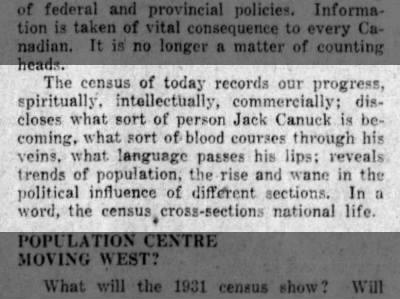

                                               
                                                    Sun, Nov 30, 1930 – 37 · The                                                     Province (Vancouver, British Columbia,                                             Canada) · Newspapers.com

The Census & Jack Canuck,  "How Many And Who Are They? Canada Plans the Census" by Grant Dexter, The Province, 30 November 1930, page 37.


Most researching their Nordic families in Canada will be looking at the historical censuses. We are often 'spoiled for choice" as a number of census databases are available, some free as is Library and Archives Canada (LAC).  See the LAC Census page for links to the free databases there and to much helpful information about the censuses and searching, including common abbreviations. The FamilySearch Wiki has a good Canada Census database chart showing LAC and the other choices.   

Depending on which database you choose, you may be offered specific details to add to your tree. As I mentioned recently in another article, I hope you will want to go beyond the hints. Occupation, for example, is included, as is ethnicity or 'race'. (These are historical documents and you will see terms used on the census or in the instructions that we would not use this way today.) This information can help you determine whether you have the correct individual or family, and open up doors to learning more about their lives in Canada and, if immigrants, before.

If researchers live in Canada, they'll likely have had the experience of talking to a census enumerator at their door or filling out a census form themselves. I remember quizzing my father later about his answers. I didn't think he had been 'truthful' and I was quite surprised by that. (Although I didn't quiz him till after the enumerator had left.) He only wanted to be 'Canadian' and wasn't going to say he knew where his family was from. In one sense, he was truthful, sort of. We did know for sure his mother was born in England. But at that time, it was only the father's line they were interested in. Dad did know his father was born in Toronto, Ontario, but did not know for sure where his paternal grandfather was born. I was pretty sure even then he was from England, but we had no evidence! 

Looking at the census answers we always need to remember that individuals had their own ideas, worries and reasons for answering questions a certain way. We can't take any information for granted. Still the census is good evidence for their being (usually) in a certain place at a certain date with (or without) certain people. See below.

We also need to remember that enumerators were the same with their own ideas, worries and reasons for doing things a certain way. And they were bound by obligations and any number of questions and regulations that changed from census to census.  

Statistics Canada has a useful timeline of censuses outlining some of the changes up to 2016. The 1871 census, for example, was the first to enumerate people de jure - according to their usual place of residence, not where they were.

Family Tree Knots has links to most of the Canada Census Enumerators Instructions 1851/52-1921. These often explain 'odd' entries and abbreviations we see. 

Here is a link to the 1926 Census Instructions to Commissioners and Enumerators. Note for instance the 1926 instructions regarding those born in Russia, "before the war", later Finland, to enter "Finland"as their place of birth (the province/state or region, or a city or town), not "Russia". (Most of the Instruction booklets are on the Internet Archive and if you are using LAC's free census indexes and images, links to the Enumerators' Instructions are in the information sections.)


The Canada Year Book, 1948-1949, Chart, "Immigrant Arrivals, 1867-1947", Dominion Bureau of Statistics, Department of Trade and Commerce, Canada, Ottawa, 1949, between pages 178/179.  Statistics Canada Open Licence. Canada Year Book Historical Collection, Archived Content. 


For much more about Canada's historical census, read Dave Obee's book, Counting Canada, A Genealogical Guide to the Canadian Census, 2010.

Another article in this series will be about researching the historical content of the census, particularly as applies to immigrants to Canada. 

Tuesday, September 29, 2020

Nordic Genealogy Conference - When Should You Try to 'cross the ocean'

Looking forward to hearing more about Nordic genealogy this week.

More about the Nordic Genealogy Conference - on right now virtually - and the National Nordic Museum in Seattle, Washington, USA here: https://www.nordicmuseum.org/genealogyconference

Photograph titled: "Edwin A. Alm and his family in Sweden before coming to Canada". Photographer unknown. Courtesy Edwin A. Alm / Library and Archives Canada / PA-102051. No restrictions on use. The collection also includes biographical material and photographs of family members.

In genealogy, when tracing immigrant families in Canada, often you hear a warning not to look overseas until you've gathered as much information as you can from Canadian or North American records, and analyzed it for details to shape your history of their life here, and for details which will help you pin down where they lived before emigration. 

Now, I want to stress that this is good advice and often can save hours (maybe years) of frustration. Many of us have common names, and family that lived in well populated places. It's all too easy to follow the wrong family and end up tangled up in all the wrong places. Don't jump to looking for Johnsons, Eriksens or even Rydbergs overseas without good solid grounding.

But once you have a few specific details on the 'original' immigrants or first generation Canadians, including any known siblings (like years of birth, year of immigration, first residence in Canada), perhaps clues for place names of birth or residence locations overseas, and if your names are not too common, you may be able to give your research a boost by checking family trees from overseas.

Doing research on Nordic families in overseas records can be frustrating if you don't have all the right information (and don't know the language yet). And if you are looking overseas for immigration dates and places people were going to, it can be very unsettling to see over and over - in any language - just "gone to Canada" or "America" or "North America". 

Yet many times, it seems immigrant families and those back home were in touch, usually with letters or postcards, at least for the first years or the first immigrant generation. But after several generations and migrations across country or borders, family members lost touch. But those letters or postcards in the home country may have been saved. Family members overseas could be searching now too but with very old but specific details.

If I have what I believe is good information on the earliest immigrants to Canada and their children, I often do searches in family trees on websites I know have more Europeans among their customers. 

MyHeritage is always one of my choices for this. Searching the trees there includes the MyHeritage trees, and those at Geni.com (a MyHeritage company) and the FamilySearch.org tree, so it's a wide search. (If you don't have a membership, you may see free search results and may have full access at a library or a Family History Centre.) https://www.myheritage.com 

Another choice might be Geneanet.org. This European based website is mostly free; premium features are available. 

Both these companies do have free offers. Right now Geneanet.org has its digital library free for all from September 28-October 4, 2020.  https://en.geneanet.org/

Since my personal Nordic interests are mainly in Sweden, I also belong to DISBYT, a tree database created by the DIS (Föreningen för Datorhjälp I Släktforskningen) in Sweden. This gives reciprocal access to Finnish and Norwegian tree databases too. https://www.dis-sweden.org/

Tread cautiously with family trees, but stay optimistic! 

And, do keep washing your hands.


Monday, September 28, 2020

Nordic Genealogy Conference - MY 50 WEBSITES ALL GENEALOGISTS COULD USE…

 Great conference so far. I've really enjoyed the keynote sessions.

Looking forward to all the upcoming sessions.  

More about the Nordic Genealogy Conference - and the National Nordic Museum in Seattle, Washington, USA here: https://www.nordicmuseum.org/genealogyconference


Today I'm offering my free and just updated list of

  "50 WEBSITES ALL GENEALOGISTS COULD USE…."

While these are not specific resources for Canada or Scandinavian areas, all are sites useful for many places and times and should prove useful to you, if you're not already familiar with all of them. 

I know the list name says "50" but there are really 52, so you could explore or try out one a week.


Map and quotation, courtesy Wyman Laliberte, on Flickr. 

Distribution of Ethnic Groups in the Interlake Region of Manitoba, Canada, 1961.

"One of the most complex distributions of ethnic groups in rural Canada is found in the Interlake area of Manitoba. Since census statistics are only given by municipal units, it is difficult to get exact distributions. T.R. Weir, Professor of Geography at the University of Manitoba, overcame this problem by means of detailed field studies in the Interlake, so that the true picture of the diversity emerges. 

Briefly stated, some of the concentrations are due to early settlement nuclei, such as the Icelanders at Gimli, the British at Teulon, and the French at St. Laurent. Other areas were not settled at an early date because the land was undesirable for farming. 

Most of these remaining districts were eventually taken up by the Ukrainians after 1900, assisted by the British near Eriksdale, in the area of soldier settlement. In 1961 the number of people in the largest ethnic groups were as follows: British 5,821, Scandinavian 5,238, Ukrainian 5,122, Indians 3,555, French 2,817, Russian 2,243, Polish 2,107."

Warkentin and Ruggles. Historical Atlas of Manitoba. map 297, p. 552.

---------------

The People of Manitoba 1951-1961. E.F. Sharp and G.A. Kristjanson. Manitoba Department of Agriculture and Conservation. Winnipeg 1964: 41.

Printed in T.R. Weir. Rural Population Change and Migration, Interlake District, manitoba [1941-1961]. Prepared for the Rural Development Committee, Province of Manitoba, Manitoba Department of Agriculture and Conservation. Winnipeg [1966]. Map 9: 69.


Thursday, September 24, 2020

Nordic Genealogy Conference 2020 - Scandinavian Research in Canada - Place Names

 First, a reminder - it's almost time for the VIRTUAL NORDIC GENEALOGY CONFERENCE. 

September 26-27, 2020 - Registration and details: https://www.nordicmuseum.org/genealogyconference

For my session on Researching Scandinavians in Canada, there will be a handout.  Over the next week, I'm featuring daily a tip or source to help with researching in Canada. And on this website, you can check out my page of Canada Genealogy - Essentials for more Canadian genealogy and family history sources.

Today is about Canadian place names. (I'm intending to do maps in a later article.)  When you find an unfamiliar Canadian place name in a document or book or a family tree, where do you go to find out where that place is (or was)? Or worse, what if you find a written place name you can't quite make out? 

Here is my first online choice. The Geographical Names in Canada database of Natural Resources Canada lets you search by name, likely the most popular search, and if you only know part of the name, use the wild cards to broaden the search -* for any character sequence or ? for a single character).

If you couldn't read all of Sointula, for instance, a search for S*tul? might give you a lot of results. But narrowing this down to British Columbia, if you already knew the Province, or by Populated Place (and I'd add Unclassified) for Feature Type, just in case, and All for the Status - only one result. (They won't all be that easy.) 

Sointula Rupert Land District British Columbia Community Official

Clicking on the Sointula result takes us to a page with a map and much more geographical information, including a search for nearby place names. You will soon see that the nearest community is 6 km away, and the nearest town 7 km, the nearest city, over 270 km. 

If you knew a family lived in a town near the Riding Mountains in Manitoba, you could search for occupied places nearby. Or if you have family homestead details, you could do the same to find out where they may have sold their grain, or likely got their mail if you haven't found that in any other sources or want to confirm.

Each Canadian province and territory has a department for its own place names and participates in the Geographical Names Board of Canada which authorizes place names in Canada. There is much more information about this on the website. 

Here is the list of all the provincial and territorial geographic websites and contacts. If you go to British Columbia's website, what more can you find out about Sointula? 

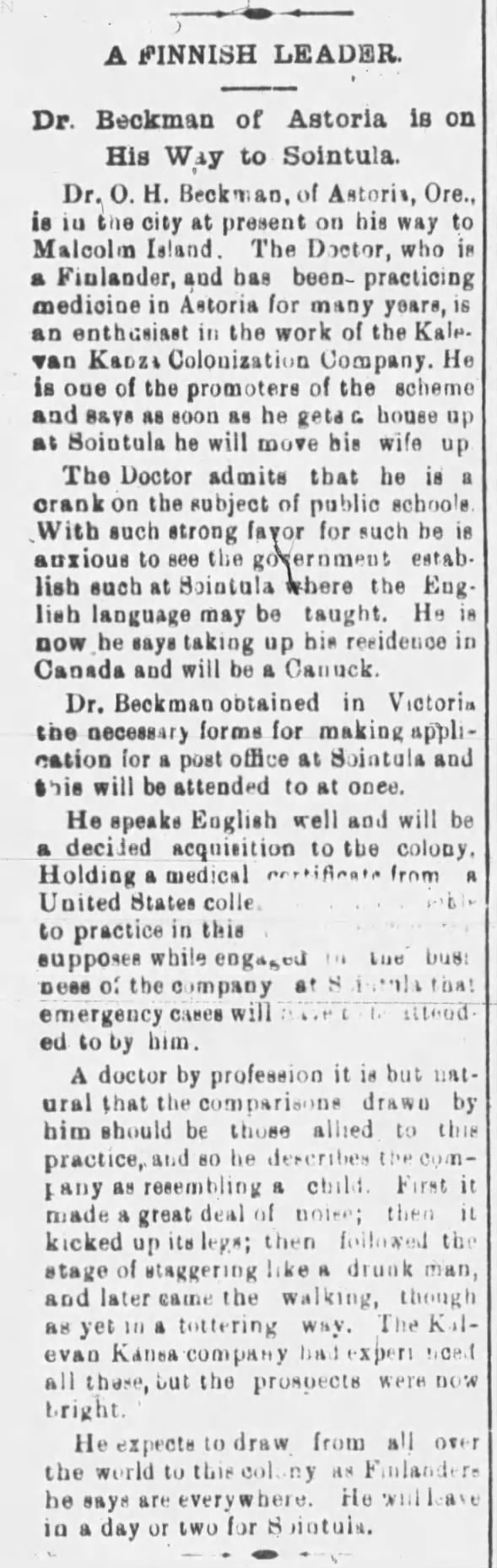
Another source I like for occupied place names is Library and Archives Canada's searchable database of Post Offices and Postmasters (also Post Mistresses) for most of the years from 1851 to 1981. No records survive for 1875 to 1902. This search tells you when a post office was authorized, usually once the area's population had grown a bit, and who was appointed as postmaster over the years. And may include more genealogical information. Library and Archives Canada or other archives may have other related records. Here is a newspaper article about Sointula's first postmaster, a Finlander.  


Dr. O. H. Beckman, on his way to Malcolm Island, in British Columbia. (Sointula), June 1902.
Dr. O. H. Beckman, on his way to Malcolm Island, in British Columbia. (Sointula), June 1902. Thu, Jun 12, 1902 – 3 · Nanaimo Daily News (Nanaimo, British Columbia, Canada) · Newspapers.com

Wednesday, September 23, 2020

Nordic Genealogy Conference 2020 - Scandinavian Research in Canada - Newspapers

Newspapers have to be my 'favourite' genealogy resource. And while I've spent many happy hours reliving other decades in microfilm, I surely do love having access to digitized versions at home. 

Canada does not, I'm sad to say, have any national digitizing project(s) for historical newspapers. However, we did, over time, amass extensive collections of French and English language newspapers, and some newspapers in other languages, and some specialized newspapers, including labour papers. Almost all were microfilmed, and now are being s-l-o-w-l-y digitized. The good news is that most of those digitized are now available free on line. 

My first stop now searching for digital newspaper archives on-line is at The Ancestor Hunt. This is Kenneth R. Marks website and he has lists of on-line Canadian digitized newspapers. He also has links to online indexes for newspaper indexes, and for obituaries which may be useful to you. 

Library and Archives Canada has a list of the microfilmed newspapers sorted by province - the .pdf versions are likely the most helpful. Each entry includes the newspapers name, LAC call #, the dates the paper started/finished; and any later names. For example, this entry under Manitoba - Winnipeg: 

"Öldin : an Icelandic weekly record of current events and contemporary thought. NJ FM 866 Sept. 3, 1891-1893. AN 7537368"

It is always worth searching to see if there is more information about the newspaper's history and the topics and points of view covered. In this case, the newspaper did have another few years, 1893-1896. 

The University of Alberta maintains a searchable database created by Sathya Rayo which may be helpful - the Canadian Minority Media Database:  http://www.artsrn.ualberta.ca/MinorityMedia/  

Provincial, local and academic archives and museums and private collectors may be holding newspaper issues. 

While I would always try to search in any appropriate non-English language newspapers, I do recommend first searching the English or French language papers, depending on the areas of Canada you are researching. 

You may find articles directly mentioning your family member in two or three different newspapers, and one or all could be from clear across the country (or in another country). 

I usually start out searching using known names or places, but if little is found, I broaden that search, especially in the English or French papers. In the case of accidents, for example, it could be that names have changed, or that no names are mentioned in an article, but place of birth might be - "A Norwegian longshoreman..." 

This is especially important if you do not read the appropriate language. Once you have some confirmed details, you can search non-English newspapers more successfully. 

If you are lucky, and patient, for instance, you might find how your Swedish grandmother could have ended up working in Sointula, BC, known first as a Finnish Utopian community. She might have replied to this ad in the 1920s.

Woman cook wanted - restaurant in Sointula, BC, Canada, 1928.
Woman cook wanted - restaurant in Sointula, BC, Canada, 1928. Sat, Mar 10, 1928 – 20 · The Vancouver Sun (Vancouver, British Columbia, Canada) · Newspapers.com
Even when newspaper articles don't answer our questions directly, they may offer us a glimpse of life in a certain community at a given time. You shouldn't believe everything you read in the news, of course! Look for other evidence to strengthen your analyses.Here, for example, is all the news from Scandinavia in Manitoba in October 1909. Scandinavia is a town, now in the Municipality of Clanwilliam – Erickson; the Scandinavia post office opened in 1886, The news shared in this column could back up a family story of how strange the weather was that year the horse drowned, or confirm the name and home residence of a family's favourite teacher. Or if Erick Carlson was your relative, when he left Manitoba's winter for "greener fields, in B.C."

Scandinavia, town column, Minnedosa Tribune, Minnedosa, Manitoba, Thursday, 21 October 1909, Formerly in the Manitobia Collection, now in the University of Manitoba UM Digital Collections, Attribution 2.5 Canada (CC BY 2.5 CA).

September 26-27, 2020 - Registration and details.Virtual Nordic Genealogy Conference: https://www.nordicmuseum.org/genealogyconference