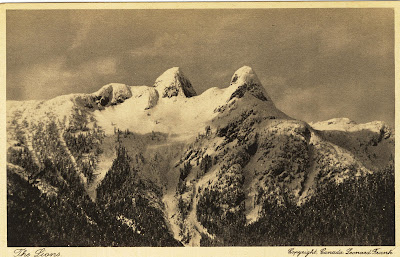
The Lions, British Columbia, Canada, [1919]. Photographer Leonard Frank.
Unused Post Card, divided back. black and white. Importex Company, Vancouver, B.C. Imprime en Allemagne. To see more Leonard Frank photographs, go to the Vancouver Public Library's Leonard Frank Collection. WHITE is the theme for the upcoming edition of A
Festival of Postcards. Evelyn Yvonne Theriault, the Festival's Editor, who blogs at
A Canadian Family, is accepting anything related to
white on postcards, even cards that are
black and white.
I entered a Manitoba cemetery related card already in this Festival of Postcards, over at my Graveyard Rabbit of British Columbia blog, but today I want to feature some British Columbia postcards.
I also want to take this opportunity to wish David Mattison, a tireless British Columbia researcher, librarian and archivist, a very happy New Year and a very happy retirement. His "
Camera Workers: The British Columbia, Alaska & Yukon Photographic Directory, 1858-1950" and "The Camera Workers Bibliography" are indispensible to those interested in BC photographers. He is just retiring after 3o years at the Provincial Archives, and said the other day in an e-mail that he is especially proud of introducing automation and championing electronic on-line access for the Archives catalogues. (Read his
Ten Thousand Year Blog for up to date news on digital issues.)
I quote from his e-mail:
Equally as important to me as significant and long-lasting memories are of experiencing someone else's joy at finding a tiny or a large part of their history in the archival records preserved by the BC Archives, Royal BC Museum. (David Mattison to the Archives Association of BC e-mail list, Thursday, December 17, 2009.) Thank you, David. I've benefited personally both from your work at the Archives and your many personal historical projects as have many others researching their family histories in British Columbia.
Now, of course, at this time of year in Canada, thoughts of
WHITE almost always bring snow to mind, although in British Columbia, even in the very southwest mainland area where I live, snow can usually be found somewhere (higher up anyway) all year round.
Most of the year, I can see some snow on the Lions, for instance, the two local mountain peaks shown in the Leonard Frank postcard above.
The Lions name was officially adopted in 1924, but the Lions are also known as the Sisters, Ch'ich'iyu'y Elxwi'kn, or
The Two Sisters as Pauline Johnson, the poet, recorded. The West Lion is 5401 feet high; the East Lion is 5245 feet. This is my favourite photograph ever of the Lions.
Grouse Mountain, 4100 feet above sea level at its peak, is a well used recreational area, winter and summer, whether there is snow or no.
 Here's one postcard though to prove we do have snow, even in June! Sleighing on Grouse Mountain, BC, in June. Alt 4300 feet. 103,904 JV. Love Photo. Souvenir Post Card, coloured, unused. The Valentine & Sons' Publishing Co., Ltd. Montreal and Toronto. Published in Great Britain
.
However, snow isn't the only WHITE connection a postcard or a postcard image can have. I've been thinking recently about why and how people collect certain things, like postcards, for instance. My tastes and my collections are 'eclectic' to put it in a nice way... but if I were collecting WHITE related British Columbia postcards I might hunt for -
Cards that relate to places named WHITE, like this lovely one that shows White's Creek Bridge in the Fraser Canyon.
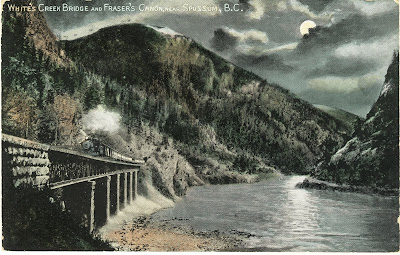 White's Creek Bridge and Fraser's Canon, near Spuzzum, B.C
.
Coloured. Souvenir Post Card; unused. The Valentine & Sons' Publishing Co., Ltd. (I believe White's Creek is now officially Findlay Creek. Why I do not know...)
Or I might look for postcards that relate to places or people with names or other historic or common associations with WHITE, like this favourite from my British Columbia postcards, showing a place associated with pearls.
 Spray of Pearls Falls, Indian River Park, "Wigwam Inn" Vancouver, B.C. Dominion Photo Co. Postcard; coloured, unused. This is now in Say Nuth Khaw Yum Heritage Park, Indian Arm Provincial Park.
If I was going to collect 'WHITE' British Columbia postcards, I'd need to be on the lookout for any cards associated with these places I've identified already (or perhaps with complementary themes, like BLACK). I've identified some places to start with. This might involve a lot of research as some names are used in more than one area of British Columbia, and many names are no longer used, but a groups of postcards collected around this theme could make a great display.
I’m making no pretense of this WHITE related place name list being complete. I’m sure there must be many places in British Columbia that would fit here. Please let me know of them.
Some of the sources I used were
British Columbia Place Names by George Philip Vernon Akrigg and Helen Brown (Manning) Akrigg (Vancouver: University of British Columbia Press, third edition, 1997), the 1931 Wrigley’s
British Columbia Directory and the GeoBC BC Geographical Names database on-line:
http://ilmbwww.gov.bc.ca/bcnames and the new book,
Encyclopedia of Raincoast Place Names: A Complete Reference to Coastal British Columbia by Andrew Scott (Madeira Park, BC: Harbour Publishing, 2009).
Blackie Spit – at White Rock (named after a blacksmith named Walter Blackie!)
Bones Bay – Steamer landing – Minstrel Island. reached by Union Steam ship from Vancouver (1931) – cannery – possibly related to Minstrel Island’s name ( 'Mr. Bones' and 'Sambo' being stock characters in minstrel shows.)
Bones Creek – see Bones Bay – also Sambo Creek.
Brides Creek
Bridesville – Greenwood – really named after a David McBride though apparently.
Bridal Creek – Popkum/Chilliwack.
Bridal Falls – Popkum/Chilliwack.
Bridal Lake – formerly Summit Lake – renamed in 1964. “This was the site of the Commonwealth's first outdoor Cabinet meeting, in conjunction with the highway's opening ceremony 15 August 1964. Order in Council 2282, passed on the spot, changed the name of Summit Lake to Bridal Lake, to symbolize the marriage and unification of the formerly separated areas of East and West Kootenay.”
Bridal Veil Cascade – mouth of Joker Creek, Kokanee Glacier Provincial Park.
Bridal Veil Creek - Kootenay Lake.
Bridal Veil Falls – on Bridal Creek, Cheam Lake, Chilliwack.
Bridal Veil Falls - On Whisky-jack Creek, north side of Yoho National Park – now Whisky-jack Falls (1970).
Bridal Veil Falls Park - Provincial Park 1965.
Bridalveil Creek (one word) - Kootenay Lake.
Cottonwood – Quesnel.
Cottonwood Canyon – Cariboo.
Cottonwood Flats – Salmon Arm.
Also perhaps,
Lambs – reached by the Union Steamship from Vancouver (1931).
Mayo – an E & N railway flag station.
Osprey Lake – a CPR flag stop - Yale.
Oyster River – Comox/Alberni.
Pages – SS Skeena – New Westminster.
And the pearls -
Pearl Harbour - Finlayson Island.
Pearl Island - Village Island.
Pearl Lake - Buttle Lake.
Pearl Peak - Iroquois Ridge.
Pearl Point (159) – previously Camp Point. Tsimpsean Peninsula, north of Prince Rupert.
Pearl Rocks - Pennask Lake.
Pearl Rocks - Sea Otter Group, south of Calvert Island.
Pearly Lake - McQuillan Range, Cassiar.
Spray of Pearls Falls – Wigwam Creek, above Wigwam Inn, Indian Arm. (The name could have come from a sad, but romantic story, or could have a more prosaic derivation. )
And,
Poplar Creek – Kaslo.
Poplar Grove – Penticton.
Shoal Bay – Lower Thurlow Island – reached by the Union Steamship (1931).
Snowshoe – Fort George.
Soda Creek – Quesnel.
Sugar Lake – east of Mabel Lake.
Sugarloaf Mountain – Nicola Lake (named for the sugar that some Douglas fir trees on the mountain produced. Akriggs).
Sugarloaf Hill - Goldstream.
Sugarloaf Hill - Kamloops.
Sugarloaf Mountain - Okanagan Lake just below Whiteman Creek, Vernon.
Sugarloaf Mountain - east of Merritt.
Sugarloaf Mountain – near head of Beaver River on South boundary of Glacier National Park, Golden.
Sugarloaf Mountain - Pemberton.
Sugarloaf Mountain - NW side of Choquette Glacier, E of Stikine River.
Sugarloaf Peak - Whidbey Reach Gardner Canal, just SE of Kemano.
Then there's
Rainbow - CNR flag stop, near Fort George.
Rainbow - flag stop PGE railway, near Lilloett.
Rainbow Falls - reached by Burrard Harbour Navigation Co. (1931).
Chameleon Harbour – reached by Union Steamship from Vancouver (1931).
And, just a few of the WHITEs - there are almost 200 -
Kluskus Lakes – from the Carrier language – meaning place of small whitefish.
Kwadacha River – Sekani word for ‘white water”. [Also now a park.]
White Boar Lake - Mallandaine Creek, Kootenays.
White Creek - Dewar Creek just above St. Mary River, west of Kimberley.
White Creek - name no longer accepted - into Bromley Creek, Yale.
White Creek - Salmon Arm, Shuswap Lake.
White Creek - Sandon Creek, Kootenay.
White Creek - Lakelse River.
White Lake – Keremeos/Okanagan Falls.
White Lupine Ridge - east of Lilloet Lake.
Whiteman Landing – Okanagan Lake - not an official name.
White Pelican Park - near Williams Lake (also Stum Lake Park). Established 1971 to protect the American White Pelican.
White River – HBC trading post, north of Fort Grahame.
White Rock – on Great Northern Railway line – Vancouver area.
White Sulphur – Eastern British Columbia Railway line – Fernie.
Whitewater – Hudson's Bay Company post – north of Fort Grahame.
Whytecliff – North Vancouver.
White Spit - northwest of Seal Islets.
White Spruce Creek - Hay River.
White Spruce Island - Carp Lake, Cariboo.
White Swan Creek - Henderson Creek, Smithers.
Whites Landing and Whites Landing Creek - Fraser River (not official names).
Whitesaddle Mountain - west of Tatlayoko Lake (named for the look of its glacier).
Whitesail Lake - southwest of Ootsa Lake. Named by Chief Louis of the Cheslatta Indians for its whitecap waves.
Whitesand Island - Malaspina Strait.


